The moment every car owner faces at one point or another in a mechanics workshop, looking at some unbelievably high repair quote that is practically equal to the worth of the vehicle. And if you keep pouring cash into an old banger and it keeps failing to deliver, you may already know the answer. But when do you really know that your car is too old to fix, and scrapping it is the best option?
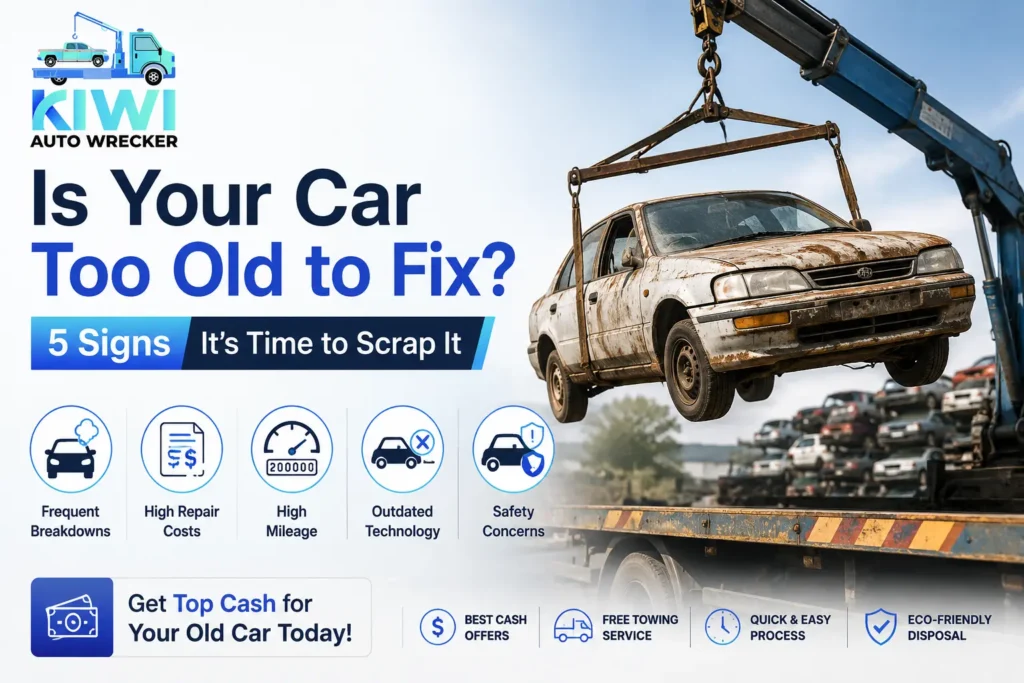
We put together this guide to show you the five telltale signs that a car is too far gone. It will also tell you what to do if you have decided to part with a damaged car, whether that means selling it or taking it to some of the more reputable junk car buyers in Christchurch.
The 50% Rule: A Simple Financial Benchmark
Before getting into the signs, one rule of thumb: if a repair exceeds 50 percent of the current market value of your vehicle, two words expect to be fridge-freezer sharers. If your car is worth $3,000 and it would cost the mechanic $2,000 to rebuild the transmission, rest assured that spending your precious cash on this particular job is almost certainly not a wise use of resources. Check out what someone might realistically pay for your car on a site like Trade Me Motors before giving the green light to any substantive work.
5 Signs Your Car Is Too Old to Fix
Sign 1: Repair Costs Exceed the Car’s Value
This is the clearest signal that old car repair no longer makes financial sense. When the cost to fix a vehicle outpaces what you could realistically sell it for, you’re pouring money into a depreciating hole.
Common offenders are:
- Engine rebuilds or replacements ($3,000–$8,000+)
- Transmission overhauls ($2,000–$5,000+)
- Catalytic converter replacements,
- Repairs for Head Gasket on High-Mileage Engines
This major repair rarely makes things right from wear, even if the car “still runs.” Within months, another component fails. This type of pattern, commonly referred to as a repair spiral, is one of the main reasons Kiwi drivers finally decide to call a wrecker.
What to do: Get a private estimate, check out Trade Me for your specific make/model/year, and concurrently and truthfully compare repair cost with true sale value.
Sign 2: Persistent Safety Issues That Keep Coming Back
A vehicle that continuously has safety problems is not merely annoying; it really puts drivers in harm’s way. And if what you are driving is in the shop over and over again for the same problems, that’s your car on its deathbed telling you to put it to sleep.
Watch for:
- Soft, grinding, or pulling brakes
- Wandering steering or steering requiring continual correction
- Suspension knocks or imbalanced wear of the tyre
- Warning lights that never fully disappear
- Airbag faults or missing restraint system function
There is no question of strict road safety standards in New Zealand. So putting other road users as well as yourself and any passengers at risk by driving a vehicle which you know to have safety defects. If your car, despite accident damage or high mileage, cannot pass a Warrant of Fitness (WOF) without huge expense required to make it road-legal, the vehicle has done a safe service life.
Sign 3: It Fails WOF or Emissions Standards Repeatedly
The WOF system in New Zealand is there to ensure that dangerous vehicles don’t end up on the road. If your car is failing inspections and you need to spend thousands just to pass an inspection, that’s a pretty good signal that the car in question has long since become unroadworthy.
Older vehicles often struggle with:
- High exhaust emissions from worn engines
- Brake and suspension wear that can’t be cheaply remedied
- Rust affecting structural integrity (checked during WOF inspections)
- Lighting, glazing, or windscreen issues
A single failed WOF is normal. Two or three in a row, combined with mounting repair costs, is a pattern. At that point, the honest repair vs. replace car calculation almost always tips toward replacing or scrapping.
Sign 4: Severe Rust or Structural Damage
Surface rust is cosmetic. Rust that goes through to the chassis, floor pan, sill parts, or suspension mounting points is a different kettle of fish; it’s structural, and it could kill you.
Corrosion escalates in older vehicles in these areas; this is notable around our coastal regions and some high-rainfall areas such as Canterbury. Once rust penetrates:
- The chassis or subframe — the car can flex or collapse in a collision
- Suspension mounts — handling becomes unpredictable
- Brake lines — brake failure risk increases significantly
- Floor pans — structural integrity is compromised throughout
Structural rust is rarely economical to repair. The labour alone to cut out and replace structural sections often costs more than the vehicle’s entire worth. It goes for heavy impact accident damage as well: the engine may run again, but in reality, a bent or twisted chassis is a write-off.
Sign 5: Replacement Parts Are Scarce or Prohibitively Expensive
Replacement parts – particularly used ones- are going to be scarcer and more expensive the older a vehicle gets. Discontinued models, imported vehicles, or cars with specialised electronics can become nearly impossible to maintain affordably.
Signs this is becoming a problem:
- Your mechanic regularly struggles to source parts
- Parts must be imported, adding weeks and high cost
- Second-hand parts from wreckers are the only affordable option, and even those are drying up
- Labour costs are high because the car requires specialist knowledge
This is especially common with late-90s and early-2000s Japanese imports, older European models, and vehicles with discontinued electronic management systems. When the parts cost more than the car, it’s time to consider selling to junk car buyers who can strip and recycle what’s left.
The Environmental Case for Scrapping
Eco-friendly car disposal isn’t just a buzzword; it’s genuinely better for New Zealand’s environment. When vehicles are done professionally through licensed vehicle removal:
- For instance, steel, aluminium, copper, and plastics are recycled up to 80%
- Fluids (engine oil, coolant, brake fluid, refrigerants) are drained and disposed of in an environmentally conscious manner to ensure soil and groundwater are not contaminated
- Usable parts are harvested and resold, reducing demand for new manufactured components
- End-of-life tyres are processed through certified channels
Letting your old car rust in your lot is not only unsightly, but leaking fluids also cause real damage to the environment. It is always better to dispose of your vehicle responsibly by going through a licensed wrecker company.
What Happens When You Sell to Kiwi Auto Wrecker?
If your car matches any of the signs above, here’s what the process looks like with Kiwi Auto Wrecker, one of Christchurch’s trusted car wreckers:
- Free vehicle assessment — describe your car’s condition and get a quote
- Instant cash offer — fair cash for junk cars based on make, model, condition, and parts value
- Free collection — we come to you, no towing costs
- Same-day or next-day pickup in most Christchurch areas
- Paperwork handled — we manage the deregistration and disposal documentation
We purchase any make and model. Please tell us the condition of your vehicle: damaged, non-runner, flood-pounded auto, or simply anything old diesel you would prefer not to have.
Frequently Asked Questions
Regular maintenance, oil changes, brake pads, filters, and tyres are expected and usually worthwhile. A car becomes “too old to fix” when major mechanical systems (engine, transmission, suspension structure) fail repeatedly or require repair costs that approach or exceed the car’s market value. Use the 50% rule: if one repair costs more than half the car’s current worth, seriously consider scrapping instead.
Compare three figures: (1) the total repair cost quoted, (2) the car’s current market value if sold today, and (3) what cash for junk cars you’d receive if scrapped. If the repair cost exceeds the market value, or if you’d need multiple repairs within the next 12 months, scrapping and upgrading is usually the better financial decision.
Yes. Car wreckers like Kiwi Auto Wrecker buy non-running vehicles. A car with a seized engine, snapped timing belt, or collision damage still has value in its parts and scrap metal. You don’t need a running vehicle to receive cash for junk cars.
Scrap value depends on the vehicle’s weight, make, model, year, and which parts are still salvageable. Heavier vehicles (SUVs, utes, vans) generally return more than small cars. Vehicles with intact engines, gearboxes, and body panels fetch more than stripped shells. Contact Kiwi Auto Wrecker for a free, no-obligation quote specific to your vehicle.
For end-of-life vehicles, yes. A private buyer for a car with safety issues, severe rust, or recurring mechanical faults is rare, and selling a genuinely unsafe vehicle raises ethical and legal concerns. Professional eco-friendly car disposal through a licensed wrecker ensures hazardous fluids are managed safely, recyclable materials are recovered, and you receive cash without the hassle of listings, tyre-kickers, or negotiations.
Typically, you’ll need proof of ownership (vehicle registration papers or a receipt if purchased privately), your photo ID, and your bank account details for payment. Kiwi Auto Wrecker handles deregistration through NZTA on your behalf in most cases. It’s worth confirming the specific requirements when you call.
Yes. Licensed car wreckers in New Zealand operate under environmental regulations covering fluid disposal, waste management, and parts handling. When choosing car wreckers Christchurch, look for businesses that are registered and transparent about their recycling processes. Kiwi Auto Wrecker follows all applicable environmental standards for eco-friendly car disposal.
A car wrecker (also called an auto dismantler) specialises in vehicles specifically. They assess and harvest usable parts, engines, gearboxes, doors, and electronics before the remaining shell goes to scrap metal processing. This means you typically receive a higher payout than from a general scrap dealer, because your car’s parts have value beyond just their weight in steel.
It depends on the extent of the damage. Minor panel damage on an otherwise sound vehicle may still have private sale value. But if the accident damaged the chassis, airbags deployed, structural repairs are required, or the repair quote is high, scrapping is often the better financial and practical outcome. Accident-damaged cars are difficult to sell privately at fair value; junk car buyers and wreckers assess them on parts and metal value, which can be surprisingly competitive.
Most Christchurch pickups are completed within 24–48 hours of accepting a quote. Same-day collection is often available. Payment is made on the spot at pickup in most cases.
The Bottom Line
That car is simply out of road: It isn’t a failed asset, it’s passed its own effective point of reincarnation. Retaining unwanted objects longer than necessary costs money, poses safety problems, and also does environmental damage. Being able to act rationally in the face of warning signs such as ballooning repair bills, repeated safety failures, hairline structural rust that passes its next WOF, or parts that seem impossible to find allows you to make a cooler-headed decision rather than an emotionally driven one.
If your vehicle is showing multiple signs from this list, the repair vs. replace car calculation has likely already answered itself. Kiwi Auto Wrecker offers free quotes, fast collection, and fair cash for junk cars across Christchurch and the wider Canterbury region.
Ready to get a quote? Contact Kiwi Auto Wrecker today — we’ll give you a straight answer and a fair price.
About the Author
About Kiwi Auto Wrecker Kiwi Auto Wrecker is a vehicle dismantler and car wreckers kiwi in Christchurch, based with 10 years of practical experience in the NZ car wreckers field. Kiwi Auto Wrecker draws on real-world experience to inform with hundreds of vehicles evaluated, dismantled, and responsibly recycled across Canterbury. Kiwi Auto Wrecker brings real-world expertise to help Kiwi drivers make smarter decisions about aging, damaged, and end-of-life vehicles.